Bummed. Ticked. Perturbed. Aghast. Disgusted. Deflated. Demoralized. I have been to the thesaurus and found it packed with words that fit the occasion. After trying on a bunch, I’ve decided to go with dismayed. A bit antique but doubly apt: it signifies sudden disappointment along with diminished clarity and confidence – exactly my two top reactions to the end of the Special Prosecutor’s investigation and the findings so far conveyed to us by the Attorney General.
I don’t know about you. I had hoped for better. Not just hoped. Expected. With reasons. Let me recap a few:
Paul Manafort’s frantic efforts to “get whole” with one of Putin’s favorite oligarchs;
The polling data that Manafort passed on to an FBI-certified Russian intelligence asset;
The instructions from an unnamed senior Trump campaign figure to have Roger Stone reach out to Julian Assange;
The Republican platform going soft on Russia a week after release of the Clinton emails;
The reported visit of Michael Cohen’s cellphone (if not Cohen himself) to Prague, a known hub of Russian hackers;
The ridiculous number of ill-explained meetings and contacts between Trump people and Putin people;
The endless lying.
What were they working so desperately hard to hide? Nothing as tidy as a straight-up deal to trade Russia-sanctions relief for Wisconsin, Michigan and Pennsylvania. I got that. But clearly there was a heap more bad stuff to unearth – another big swath of criminality if not a single foul deed. And surely the Special Prosecutor and his team, with all the witnesses they had turned and the records they had gathered, would know a lot and tell us a lot of what they knew. That was my wishful if not magical line of thinking.
I confess to (in hindsight) an unhealthy interest in Trump-probe minutiae, partly attributable to too many hours spent in the back alleys and basement corridors of the case with the three amiable co-hosts of a podcast called “Mueller She Wrote.” But as they say in Author’s Acknowledgment Land, any mistakes are my own.
A big one was the habit of filling the void of Robert Mueller’s silences with imputed powers and virtues. Presented with the bullet points of his life story, I discounted his service to the two George Bush Administrations and the rock-ribbed Republicanism that won him his assignment, and grabbed on to his reputation as a straight-shooter who loved to put bad guys behind bars. Coming from the polar opposite end of the spectrum of New York City privilege, our Special Prosecutor, I felt sure, would see Donald Trump as a blight on the moral landscape, and his presidency as a national disaster. Guided by a duty to history and not just by a narrow legal mandate, Mueller would conclude his probe with a decisive flurry of indictments and disclosures, setting the Trump crowd on its heels and supplying the Resistance with fuel and momentum for a final push to victory. That is the vision that must now be shelved.
Yes indeed, we still have the actual Mueller Report to look forward to. Even with redactions, its hundreds of pages could turn out to be damning – possibly in themselves, possibly in the leads pursued by others. And if, for the sake of argument, there was “no collusion,” that idea will still have been the crowbar that opened many boxes of dirty secrets. Mueller & Co. may turn out to have been playing a sounder long game than we can yet see – with better results than the country would have realized from a dramatic announcement propelling us into a nasty fight over impeachment.
Let us hope so. But let us take a moment, first, to summon our inner child and give voice to our pain. For that purpose, I recommend “Robert Mueller Hits the Dusty Trail,” the Colbert show’s mashup of the windup of the 1952 movie “Shane,” when, as Alan Ladd rides off toward the hills, the 10-year-old Brandon DeWilde begs him to “come back” and deal with all the unanswered questions and uncompleted investigations.
A good cry will serve us well. Then we can get to work and face the fact: there will be no savior. It’s on us.
Conspicuously absent from the list of colleges implicated in last week’s epic admissions scandal was my alma mater, Harvard.
The story continues to unfold, of course. Perhaps in time, the Harvard community will learn of an underachieving child of privilege or two who did gain entry into our school through the good offices of William “Rick” Singer of Newport Beach, California, and his system of phony test scores, coach-bribing and manufactured records of athletic accomplishment, carried out under cover of a counseling firm called The Key.
For now, however, it appears that Harvard, unlike Yale, Georgetown, Stanford, UCLA, Wake Forest, and USC, was not considered worthy of the trouble and expense.
I don’t know how my fellow alums are feeling. Personally, I’m disappointed. When I hear about TV stars, Wall Streeters, corporate executives and a vineyard owner spending megabucks to get their offspring into prestigious institutions of higher education and then taking care to dress it up as an act of charity, I expect Harvard to figure prominently.
I was therefore pleased to discover that our school turns out to have played a supporting role in this tale. Singer, according to follow-up reports, was aided by a member of the Harvard class of 2004 and an officer of the Harvard Club of Sarasota, Florida, Mark Riddell. A top NCAA tennis player in his undergrad days, more recently employed in the college placement office of a Florida prep school and sports academy, Riddell was the pretend proctor who sat with applicants (after they had been falsely diagnosed with conditions justifying a private testing environment) in order to amend and improve their answers on entrance exams. Over a seven-plus-year period ending in early 2019, he is said to have made upwards of $10,000 a shot for each of many trips to test sites in California or Texas. “He was the one,” as The Washington Post put it, “actually filling in the bubbles.”
Facing charges of conspiracy to commit mail fraud and money laundering, Riddell has been cooperating with authorities in the hope of securing a lenient sentence – a consideration that may help explain his efforts to correct early news accounts that portrayed him as a bribe giver. He wants it known that he was strictly on the receiving end of these illicit payments.
Indeed, Harvard can take pride in the character of Riddell’s contribution to the enterprise. He had no inside access to the test answers; federal prosecutors say he was “just a really smart guy.” (You don’t often get that kind of testimonial from the people who indict you.) So smart that he could come up with just about the precise number of correct answers an applicant needed—a number high enough to impress the admissions team without being so high as to attract suspicion. Singer has described Riddell as his “best test-taker” and someone who could “nail a score—he’s that good.”
Since Riddell was not a co-founder, it would be wrong to include The Key in the honor roll of enterprises—Facebook, Microsoft, BlackRock, Bain Capital, Fitbit, OKCupid, Stitch Fix, and the rest—germinated in Harvard’s labs and dorm rooms. Like so many of the other notable startups of our time, though, this one could never have come as far as it did without at least one product of a Harvard education. That should be a comfort to us Harvard men and women.
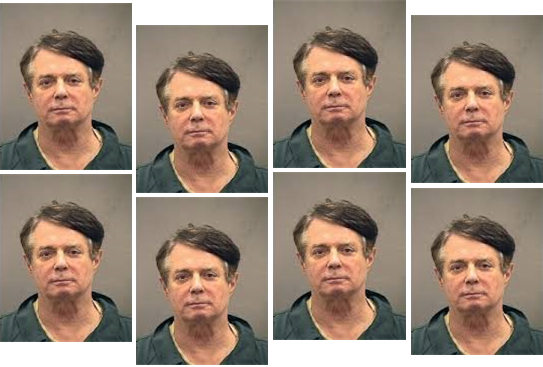
Pleading for leniency in a federal courtroom Wednesday, Paul Manafort’s lawyers pointed out that he would never have been charged in the first place “but for a short stint as campaign manager in a presidential election.”
That is sadly true, and it is a truth worthy of our attention. Manafort confessed to bank fraud, tax fraud and multiple counts of conspiracy after netting more than $50 million for ten years of illicit services to overseas dirtbags. And yet, had he merely resisted the temptation to offer his talents to Donald Trump in 2016, he would very probably be a free man and still in possession of most of his homes, vehicles, clothes and the other accoutrements of what Federal Judge Amy Berman Jackson called an “ostentatiously opulent and extravagantly lavish” lifestyle.
The “but for” scenario failed to move Judge Jackson, who added another 43 months to Manafort’s previous (and widely decried) sentence of 47 months on weightier charges assessed by a more sympathetic jurist. Nevertheless, the defense team’s observation raises serious questions—not about Manafort’s guilt or punishment but about how many other career fraudsters are running around with impunity, because they haven’t become ensnared in a history-making morass of presidential corruption?
We cannot, of course, hope for a precise answer. There is, however, every reason to suppose the number is a large one. American law enforcement has a deserved reputation for going easy on the white-collar crimes of well-off white people while reserving much of its wrath for small-time thieves and drug offenders, with extra discredit awarded to people of color. The Obama Administration served up a memorable example of this double standard by failing to send a single bank executive or securities trader to prison for the massive fraud that triggered the financial and economic meltdown of 2008-09. And if you are guessing that things have only gotten much worse in the Trump years, you are guessing correctly.
In January 2019, the federal government brought a reported 337 new white-collar crime cases—a two-decade low, 35.7 percent down from the level of five years ago, according to the latest Justice Department data analyzed by the Transactional Records Access Clearinghouse (TRAC) of Syracuse University.
The Syracuse project monitors these numbers partly to call attention to performance differences among U.S. Attorney’s offices. Many of the lawyers thus employed are well-heeled folks who have revolved out of, and/or plan to revolve into, lucrative careers in private practice – a circumstance with the potential to diminish their enthusiasm for cases against rich and powerful malefactors. We should be doing everything we can to remind them of their prosecutorial duty and call out those who conspicuously evade it. As the Manafort case reminds us, however, the ranks of law enforcement include plenty of investigators, prosecutors and judges who are dedicated to their work and even take special satisfaction (as they rightly should) from assignments that give them a chance to bring down the sort of criminals who are accustomed to thinking of themselves as beyond the reach of the law.
Unfortunately, the deck is stacked against such cases by decades of legislation and court rulings that make them exceedingly hard to prove. It took a massive investment of money and investigative and prosecutorial effort to nab Paul Manafort. That kind of expenditure, alas, is the exception, not the rule.
It sprouts. The Washington Post unearths a 1986 Texas State Bar registration card on which Senator Elizabeth Warren listed her race as “American Indian.” It’s the “first document to surface showing Warren making the claim in her own handwriting”; it is also entirely consistent with what Warren has been saying for months – that she used to identify that way but never gained any professional advantage from it. The Post accordingly relegates the discovery to paragraph 7 of a story about Warren’s apology to the Cherokee Nation for a practice that, she now understands, was offensive to many Native Americans.
It grows. Other media companies, however, make a bigger deal of the registration card. Some are simply chasing eyeballs; that would be, for example, CNN, which runs a stand-alone story about the Texas document and gives a Republican Party spokesman space to accuse Warren of “a politically opportunistic apology that doesn’t go nearly far enough.” And some are delighted to have any fresh pretext for disparaging a conspicuously popular progressive; that would be, for example, Fox News, which reports that Warren is “once again in the hotseat,” and the Boston Herald (owned by a rapacious hedge fund), which characterizes the Post story as a “stunning setback” for Warren.
It morphs. The media coverage becomes news in its own right – proof, according to the Associated Press, of Warren’s continued struggle “to move past [her] Native American heritage flap.” The AP story points to another statement of regret issued by Warren in response to the disclosure: “For the second time in two weeks, the Massachusetts Democrat apologized Wednesday for claiming Native American identity on multiple occasions early in her career.” (Warren could, of course, have declined comment; that would have stirred a comparable burst of bad press about her failure to answer “fresh questions” on the subject.)
It propagates: Now everybody wants a piece of the story, and we get a round of articles about Warren facing “new fallout” (ABC), headlines about the “Smear That Just Won’t Die” (CBS Boston), and speculation about “whether the ancestry issue will haunt Warren throughout the primary” (Politico). Meanwhile Facebook and Twitter light up with posts from pundits ready to pronounce Warren’s presidential candidacy doomed before it has been formally announced.
What should we make of all this? Herewith a few preliminary questions and answers offered for consideration by anyone in a mood to consider them:
Q: When is a scandal getting overworked?
A: When the continued life of the story becomes the story. (Note to free press: please find something better to do with your freedom than to wonder how long somebody will be “haunted” by something.)
Q: Who’s calling the shots? In October, when Warren announced her DNA test, she drew harsh criticism from Native American groups and leaders. But now the attacks are coming almost exclusively from corporate hacks and Republican hatchet-people. That should be another signal for the mainstream media to move on.
Q: Where’s the beef? What’s really bothering these folks?
A: I’m going to go out on a limb here: just possibly they are less troubled by any concern for the feelings of indigenous peoples than by the pain that some of Warren’s policy proposals would inflict on her critics and their benefactors. The proposals I have in mind include an annual tax of 2 percent on household net worth over $50 million and 3 percent on household net worth over $1 billion; a major increase in the IRS budget and the frequency of audits performed on the ultra-wealthy; a crackdown on the use of offshore tax havens; a multi-year lobbying ban for all federal employees; a prohibition on lobbyist donations to candidates for Congress; a mechanism for German-style worker representation on corporate boards; and a variety of other measures to combat routinized corruption and counter the game-rigging economic and political power of bankers, CEOs and the super-wealthy. Just possibly, I would further theorize, Warren’s critics are also troubled by her proven ability to get things done (things like the Consumer Financial Protection Bureau), and to give compelling voice to ideas that the corporate-funded Right has long been able to dismiss as creeping Bolshevism.
If that’s the stuff that Warren’s attackers are truly worried about, I say, that’s probably the dimension of her candidacy that the rest of us should focus on, too.
It’s been fun, the Howard Schultz blowback. Sources close to Schultz say he was seriously unprepared for the experience of being called an egotistical billionaire asshole by just about everyone he had not hired to help his presidential candidacy boot up. Perhaps the response will lead the Starbucks founder to decide he is not our great national savior after all. I join with many others in wishing him a speedy journey to that conclusion.
That said, I suspect there is a warning here not just for Schultz but for us, his critics. To begin with, we should watch out for the danger of thinking small—of approaching the 2020 election from a place of fear.
Behind the anti-Schultz mobilization lies the nightmare of another close contest in which victory is undone by the combination of third- and/or fourth-party candidates and a less than ideal Democratic nominee. Memories of 2000 and 2016 make that scenario vivid. Anticipation of a second Donald Trump term makes it horrifying.But a close contest is hardly foreordained. Given the way things have been going lately (the government shutdown, the indictment of Roger Stone, the latest plunge in the President’s approval ratings), an easy win for the Democratic standard-bearer seems just as likely.
By crunch time next year, Trump could be doomed, assuming he’s on the ballot and remains President.An independent candidate could be the least of our concerns, even if one or more are in the mix, as they may well be regardless of what anybody does to discourage them. The suspense by then could be about the magnitude and meaning of the victory. Comfortable or landslide? Normal pendulum swing from one party to the other, a la 2008 and 1992? Or a wave election more like 1932? At the outer end of possibility, we could end up not just with a Democratic President, House and Senate, but with a strikingly progressive and united team of national leaders confident of wide popular support.
That is certainly an outcome to hope for and, I would argue, to work for.
Consider the other scenario for a moment. If the presidential race is close, so too will be the divide in Congress, and we know how that plays out from long stretches of the Bill Clinton and Barack Obama years. When the task of getting anything done depends on even a small amount of Republican cooperation—or on the backing of every last Democrat—that puts a severe crimp on what even the best people in Washington feel motivated to stand for and ask for.
Donald Trump could be gone, Congress could be narrowly in Democratic hands, and we could still have a government incapable of dealing with climate change, chronic racial injustice, gender inequality, workplace exploitation and indignity, insane barriers to decent health care, and growing monopolistic power, to mention a few big problems. On such matters we will get nowhere or fall way short until we have a critical mass of elected officials who feel roused and empowered to resist the influence of the dirty-energy, pharmaceutical, junk-food, telecom, and military hardware industries—more broadly, to resist the influence of Wall Street and corporate America writ large. A sweeping victory is the outcome the times demand.
It is also an outcome the times make possible—more possible than at any point in our recent past, anyway. For that fact, we have Donald Trump to thank. Alongside the horrendous damage they have done, Trump & Co. have opened America’s eyes wider than ever to the perils of a crooked economy and a sham democracy.
That awakening is well underway. According to a recent Axios poll, roughly seven in ten Americans don’t just view our economic system as skewed toward the wealthy; they want the government to do something about it. In months to come, this country will be called on to pay yet more attention to the crimes of Donald Trump and his extended family, and thus to political criminality, money corruption and the runaway economic and political power of giant corporations and the ultra-wealthy. By election time, those issues could be top-of-mind for most of the electorate. Progressives certainly should be doing all they can to help make it so.
So yes, by all means, let’s continue to tell egotistical billionaires where to get off. But I am not sure we need to devote quite so many public protests, Tweets, websites and hashtags to the task. (My overnight inbox mentions #HowardSchultzDontRun, boycott-starbucks.com, and #nohowardno just for starters.)
Some of this negative energy could be advantageously redirected toward the standard-issue Wall Street and corporate Democrats in the running; Kirsten, Cory, and their ilk need to know we’re looking for something better this time around. Progressives and resisters might, in a broader sense, do well to avoid becoming too fixated too soon on the presidential contest and the fortunes of this or that contender.
For now, I say, let’s ration the time and thought we spend opposing or, for that matter, advancing any candidacy. Schultz, like Trump, is clickbait. We need to learn not to let any loudmouth with money control our agenda.
So long as Donald Trump is in the White House, he will be an opportunity as well as a crisis. Let us be rid of him. But let us also make the most of him. The 2020 results may be a letdown, of course, but there is no reason to think the election and the post-election world will turn out less well if we aim high. And having modest expectations is no guarantee against disappointment in any case. That is right up there with complacency as one of the powerful lessons of 2016 and many a recent election year.
I’ve been reading myself back to sleep with “A Voyage Long and Strange,” Tony Horwitz’s excellent account (and retracing) of the pre-Mayflower, pre-Jamestown European attempts to explore, settle and pillage the New World. I was thus engaged at about 2:30 this morning when I came across a jarring reference to “another Italian navigator, John Cabot.”
John Cabot is the guy who in 1497 paid a brief visit to Labrador (or possibly Newfoundland, or conceivably Cape Breton Island), gaining credit for the second earliest European contact with North America – second only to Leif Eriksson and his Viking band in the 11th century. Cabot sailed out of Bristol, England, and I had pegged him for a Brit. Evidently not. That was the jarring part.
Unfortunately, he exits Horwitz’s book soon after he enters. He “barely ventured ashore, discovering only some animal dung and a fishing snare,” Horwitz writes, justifying his decision to give the serious bookspace to explorers (British, Spanish and French) who penetrated further inland and saw more of the territory they claimed. (Most accounts, including Horwitz’s, have Cabot perishing on the return leg of a similarly unfruitful followup voyage. “He is believed to have found new lands nowhere but on the very bottom of the ocean,” an uncharitable contemporary commented.)
I can understand the brisk treatment. Still, I longed to understand how an Italian had come to be called John Cabot and to convince King Henry VII to license (and a group of London bankers to help fund) an expedition to “go and find the new land.”
I sought clarity online, and alighted on a Cabot “life and career highlights” slideshow provided by Google to answer just such questions. It taught me that Cabot was born Giovani Caboto or something like that, fled Italy for Spain with creditors on his trail, and got to England in 1495 with his wife and sons. “This was a good career move for John,” I read, and once in London “he developed his own website.”
Ah, Google! It turns out that the long arms of the Internet giant had scooped up chunks of information from a nutty site (the creation of two otherwise sober and upright Pennsylvania schoolteachers) known as allaboutexplorers.com. There we learn that like Christopher Columbus and the Beatles, John Cabot was born in Liverpool; that he had a half-brother known as Ringo; and that he took a large stash of DVDs with him on his final voyage. Ferdinand Magellan, for his part, fought in the Battle of Hastings, where he “lost an eye after being shot by an AK-47.”
When I woke up this morning, I reassured myself that it had not been a dream, and set out to interpret it. Here’s my quick conclusion: some companies are too damn big, which causes them to do more things than they can do well.
First there was center Jarrett Allen, who doesn’t own a car, builds his own computers and gives calculators and grocery money away to local schoolkids. Now there’s guard Joe Harris, aka “Joey Buckets,” who wears a backpack, rides the subway, and ranks just behind Steph Curry in three-point shooting percentage. Like all but one of their teammates, Allen and Harris live in the Borough of Brooklyn. The Nets make me yearn to be back there.
Bob Kuttner has been mulling this question over. His latest idea is for the Democrats to “emulate the World Cup, or one of the major tennis tournaments, and use elimination rounds. For the Wall Street Democrats, Booker against Gillibrand. For the geezers, Biden against Sanders. For the progressives, Warren versus Brown (or maybe Sanders). For the dark horses, Landrieu against Castro.”
In case that’s too much to hope for, here’s my fallback proposal: let us do whatever we can to get the Wall Street (and Corporate) Democrats to bow out early. I note that several more candidates may be fairly entitled to that label.
If I were a director casting a play, here’s what I would tell them in the warmest possible terms: “Thank you so much for coming in to read for the part, but we’re going with a different concept this time around.”
A new term for us to reckon with (new to me anyway): “the inversion.” Meaning the moment when bot traffic exceeds human traffic, and the systems for detecting fakery conclude that the bots are the humans and the humans are the bots. We are pretty much there, Max Read concludes.
The midterms are over and my newsfeed is filled with pronouncements on what the Democrats should do next. Go bolder. Go centrist. Be inspirational. Be careful. Nominate Beto. Nominate Sherrod. Draft Michelle.
So many opinions. So many reactions. One of my reactions is, Hold on a damn minute! Before we plunge into all these testy debates, might there be a more immediate question on the table? More immediate and more unifying?
The first order of business for Democrats and progressives, it seems to me, is to advance a serious clean elections/clean government agenda and do all we can to make democracy reform a front-of-mind issue for voters, office-holders, candidates and the media. That project should be at the top of the To Do list for three reasons: necessity, political advantage, and readiness.
Necessity. Consider a few thought experiments with a common plotline of “Even after we accomplish X, it won’t be easy to do Y.” That is sadly true where:
X = win the House and Y = win the Senate;
X = win the Senate and Y = enact meaningful legislation for the public good;
X = enact legislation for the public good and Y = get it declared constitutional by a federal judiciary packed with corporate stooges like Brett Kavanaugh; and
X = get it declared constitutional and Y = get it implemented and enforced by industry-captured agencies of government.
Climate change, racial justice, economic justice, worker rights and dignity – progress in every important area of policy demands a fairer political process, a more representative government, and measures to curb the game-rigging power of big corporations, Wall Street, and the ultra-wealthy. That point has been clear for a while now. It should be clearer than ever after the second straight election in which Democrats got millions more votes and Republicans still wound up controlling most of the levers of government.
Political advantage. In a pre-election NBC/Wall Street Journal poll, “the influence of special interests and corruption in Washington” ranked just 1 percentage point behind the economy as the electorate’s top concern. Democrats, with all their ethical shortcomings, held a nine-point advantage over Republicans on that metric.
Integrity problems undid a number of Republican lawmakers this year. I am not just referring to a standout slimeball like Dana Rohrbacher, the 15-term California congressman buried in headlines about his links to Michael Flynn, Natalia Veselnitskaya, Vladimir Putin and assorted other tyrants and fraudsters. Corruption also figured in the defeat ofgarden-variety slimeballs like Randy Hultgren of Illinois.
I became acquainted with Rep. Hultgren and his record through a research and messaging campaign I instigated: the Wall Street Flunkies project. Hultgren was one of our “banker’s dozen” – 13 House members with unusually cozy ties to banks and payday lenders, exemplified in his case by sponsorship of a major financial deregulation bill that turned out to have been written almost word for word by one of his top donors, Citigroup. Lauren Underwood, who beat Hultgren, ran on her public health background and commitment to the Affordable Care Act and its coverage of preexisting conditions. But Underwood’s victory also demonstrated the appeal of her campaign slogan, “Unbought and Unbossed,” which was bolstered by her refusal to accept corporate money and her team’s readiness to call Hultgren out for his special-interest favors to his biggest donors.
“Being able to tie Randy Hultgren’s bank $ to specific votes and language was very helpful,” an Underwood campaigner wrote me after the election. “Randy also took telecom $ and voted against net neutrality – which is an issue that lots of folks understand. So I think that narrative – I want a representative who isn’t beholden to corporate money – resonated… with persuadables.” Eight of the 13 major flunkies wound up losing their races. The others were Peter Roskam (Illinois), Tom MacArthur (New Jersey), Erik Paulsen (Minnesota), Bruce Poliquin (Maine) and Mia Love (Utah). See wallstreetflunkies.org for an explanation of the project and profiles of the 32 incumbents (13 major flunkies plus 19 minor flunkies) targeted.
Democracy reform proved to be a vote-getter in its own right. Nevadans and Marylanders approved measures calling for same-day or automatic voter registration. Floridians restored the voting power of a potential 1.4 million ex-felons. (Had they been allowed to vote this time around, Democrats might well have won the Florida governor’s and Senate races.) The citizens of Colorado, Michigan, Missouri and Utah decided to hand the task of redistricting to nonpartisan bodies instead of the pols currently running their state legislatures.
Readiness. These issues countedin 2018 and will have far more traction in 2020 if the coming months bring either of two likely developments. Development No. 1: Further revelations of Trump/Republican criminality. (Inevitable regardless of what happens with the Mueller probe and attendant legal proceedings.) Development No. 2: Fresh economic suffering fueled by financial deregulation, chicanery and excess. (More a question of when than if, since we already have the deregulation, chicanery and excess.)
In other words, a big change in the political weather may be brewing, and history (post-Watergate history, for example) portends a powerful anti-corruption backlash that will put Wall Street’s and corporate America’s worst political enablers at extreme risk. That would be a huge opportunity for Democrats and progressives – if they’re prepared for it.
Democrats can prepare by committing themselves to a game-changing set of new rules for elections and government service, and a code of conduct to follow in the here and now. Progressives can do their part by building an institutional infrastructure to get lawmakers and candidates to heed the call.
An agenda could draw on steps already taken at the state and local levels and proposals put forward by Nancy Pelosi, John Sarbanes, Elizabeth Warren and others. Potential elements include nonpartisan redistricting, weekend voting, runoffs or ranked-choice voting when no candidate gets a majority, and a matching-fund system for candidates who agree to strict limits on big-money campaign contributions.
A code. A self-selected group of lawmakers should publicly take a Clean Government pledge that goes beyond the requirements of law. As Alexandria Ocasio-Cortez has sensibly proposed, they could vow never to take money from an industry overseen by a committee on which they serve. Members of Congress could require every campaign contribution to be traceable to its ultimate source, and they could demand a no-future-lobbying promise from key staffers while making that same promise themselves. Perhaps they could wear a literal badge to advertise these commitments.
An outside campaign. For the agenda and code to be meaningful, they must be risky. Those who sign on could have trouble financing their campaigns and winning the approval of the DCCC and other vetters of candidate credibility. In recognition of the difficulty, progressive activists and funders need to create and strengthen institutions both to support the best role models and (in the Wall Street Flunkies spirit) to track and publicize the ethical lapses of others.
Democrats should not be exempt from this scrutiny. Without being sanctimonious or dismissive of the arguments against “unilateral disarmament,” progressives should call on them to reimagine themselves as something more – far better – than just one of two political parties using the existing tools of power to win elections and promote policies.
Republicans, after all, do not see themselves that way. They have assumed the form of a ruling party in a tinhorn semi-dictatorship. They’re in the business of subverting, not wielding, the machinery of democracy. They have taken our country dangerously far in the direction of authoritarianism, nationalist demagoguery and plutocracy. Democrats need to be the solution – the standard-bearers of fairness, integrity, and government of and by the people.
Some Democrats will decline that honor, of course. Many party elders are settled in their ways, content or more than content with the current arrangements. But others will grasp the magnitude of the occasion and rise to it, and some may even take the opportunity to lament and disown practices they have tolerated and indulged up to now. Those who do could be rewarded for their courage.
In the short run, a strong stand on democracy reform could be a way for Democrats to bridge internal differences, overcome their reputation for quarrelsomeness (to say nothing of their reputation for kowtowing to corporations, banks, and other moneyed interests), insulate themselves against the criticism and discontent of progressive activists, and forge new connections with working-class and other voters and nonvoters whose thinking about political corruption rests on the inaccurate but entirely too justified assumption that “everybody does it.”
In the longer run, politicians who take the pledge could have an easier (or, at any rate, more satisfying) experience winning office. And once in office, their chances of being of practical service to their constituents and advancing the national good would be vastly enhanced. That is the goal that should motivate them and the rest of us.




 letustalk.home.blog